
Brushfires. Better than Wildfires
China's brushfires are threatening a western wildfire - in economies and in markets


A recent substack read produced a powerful metaphor for where and how economies meet with markets, the notion of a wildfire that clears the deadwood and allows new growth to appear. It is of course the same as Schumpeter’s concept of Creative Destruction, it’s just that in the west we have spent decades trying to prevent the regular brushfires needed to ‘manage’ the forest such that, as with the California wildfires in 2020, so much deadwood has built up that when the fires eventually came that they were so intense that even some of the 2000 year old sequoias and Giant Redwoods, evolved to survive regular fires, were killed off.
Trying to stop brushfires eventually leads to wildfires. Crony Capitalism stores up future problems
The market parallels are fairly obvious, the wildfires of 2000 and 2008 are associated with financial market crashes, but were a function of economic market disruptions and, to extend the metaphor, took down most of the tall trees with them, as Cisco shrank to a fraction of its size, Enron was exposed as a fraud and Nokia and Ericsson all but disappeared. In 2008, it was the turn of the giant redwoods of the financial sector and the subsequent economic shock was a function of the massive forced deleveraging.
However, they also allowed the emergence of what are now the MAG7. The tech, streaming and social media companies that emerged from the two wildfires have dominated the last quarter century, both economically and (particularly ) in the financial markets.
Mag 7 emerged from the previous wildfires, but are now creating a vulnerability of their own
Every time we see the forest fire we in the west call it a disaster, while missing the point about what comes next. At the same time, in the west and to quote Ronald Reagan, “If it moves, tax it, if it keeps moving, regulate it and if it stops moving, subsidise it”. We are failing to clear the brush, so that when the fire does come, it will be a lot worse.
In Europe, things are arguably even worse, with large corporates using regulation and lobbying to protect their monopoly interests and now facing existential threats from China.
And this is the real problem. China’s growth has been accompanies by a series of deliberate and calibrated brushfires, associated with the rhythm of the five year plan cycle, where the pragmatic notions of Deng Xiaoping that ‘’it doesn’t matter if a cat is black or white, as long as it catches mice’’ have allowed a shadow banking system to bloom and die, as well as a housing developer market and currently, in bloom period, a massive clean energy and EV industry.
The issue now is that, as and when the brushfire is started there, it will spread to the west.
Now that China has caught up with the West, its model of creative destruction for growth is going to set fire to the protected undergrowth in the western economies as well.
The ‘problem’ is that the market cap weighted passive index buyers in the US have been allocating so much sunlight and capital to the tallest trees in the forest that the dead wood down below has been accumulating. The capital being allocated to smaller companies is largely going into the pockets of the VC and PE industries.
As the US scrambles to built power hungry data centres and Europe struggles with self destructive clean energy policies producing some of the most expensive electricity in the world, China is investing heavily in alternative energy production - especially in areas like new nuclear, thorium and fusion.
China is integrating AI into robotics and productivity enhancements while the west is focussing on social media content creation; the tech titans are making more of what they want, rather than more of what the economy might actually need. It is the equivalent of the US auto industry in the 1920s strangling the growth of public transport.
Which brings us to a strangely existential question:
Is Deflation Good or Bad?
The impact of allowing rapid growth in supply is that prices fall rapidly - think of EVs, or the cost of compute, but often our analysis of falling prices is too focussed on the asset owner or the corporate supplier, rather than the consumer. With an economy run by Wall Street and Silicon Valley and ‘owned’ by the 1%, it is easy to think that the current stance of active Keynesianism - cutting rates or channelling government spending to stimulate demand so that excess supply can clear at a profitable price is the correct one, and thus deflation is bad.
But is it? And if so, for whom?
A recent article on Bloomberg for example lamented the falling price of EVs and Tech goods in China, as well as for food, rent and other items. It had this dramatic graphic.
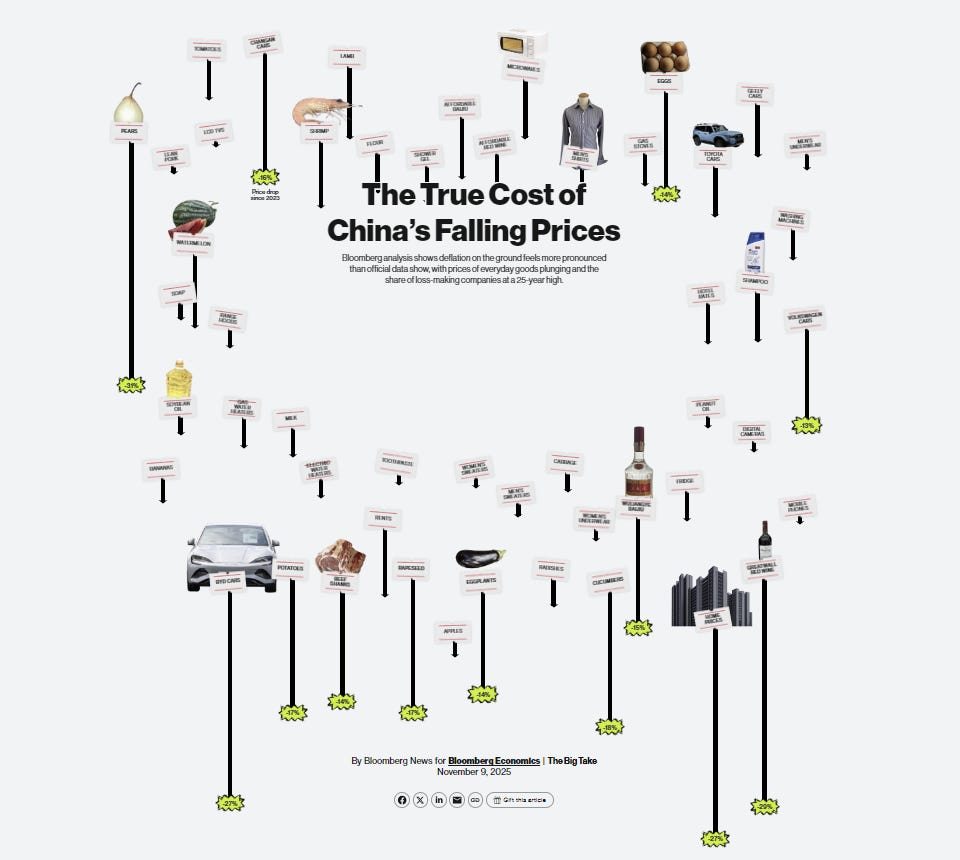
But if we step back from the Bloomberg perspective - which is how this is bad for asset owners and corporates - which, let’s face it, probably describes their main readership - it highlights the impact of what is being referred to as ‘Involution’. From a consumer perspective however, it looks very different.
Take an obvious index, the price of eggs. Bloomberg says that this has fallen 14% since early 2023. (NB. there is a problem with this in so far as there was a huge spike in egg prices in early 2023). If we take out the spike, US egg prices are up 70%.
Beef, is down 14% in China, but up 20% in the US (using Fed date versus a year ago), affordable red wine is down 30% versus flat in the US, but that’s not exactly a common consumer good in China, any more than potatoes (also listed) are. Shrimp prices are down in China, but this is a global phenomenon. Indeed, the 2023 benchmark, likely chosen to make the editorial point, has so much food price distortions from the Covid and Ukraine supply chain disruptions as to be largely unhelpful.
However, in terms of rents, the peak in 2022 is distorting for both China and US, but while US is largely back to peak (New York is up 20% on a year for example), Chinese rents are not. Bad for landlords, but not for consumers.
A BYD car is now almost 30% cheaper, but if, like I did recently, you got a ride in a Densa D9 (the premium brand originally set up with Mercedes but now 90% BYD) that was the height of MPV luxury with an equivalent of a US$46k price tag, you would think that was a good thing. Everything is becoming like your TV or your phone, better quality at lower prices.

And don’t get me started on this Range Rover ‘killer' , which is around of third of the price…and seriously good.

And this is the key point, whereas during the post 2008 period the low cost of money led to a circular flow into the stock and bond markets and elevated returns to the rentier class and the carry trade elite, in China, the brushfires that followed the deliberate collapse of the property bubble and the post Covid era have led to an extra-ordinary increase in capital going into the economy, which has led to excess supply dragging down prices.
The Chinese know that the answer is not to force consumers to raise debt to match demand to supply , even if Western economists don’t appear to see it that way.
If you get your views on China from much of the western press - or even much of YouTube - you will likely believe that China is a disaster, but it is worth reading a bit more widely and remembering that, even with slower growth, China is still growing at around 5%, adding the equivalent of an economy the size of Thailand to the global economy every year.
Moreover, even with flat incomes, (also true in the west) real wages are rising in China, just as real interest rates are low. Consumption is not following western modelling because the Chinese do not borrow to consume in the same way.
The Bottom line
Over the last 25 years, the west has suffered from a misallocation of capital in the wake of the zero interest rate responses to the two big wildfires. The collapse of interest rates in the wake of the TMT bubble bursting, fuelled the over-leveraged housing bubble that burst in 2008. The MAG 7 were unaffected as they built businesses on very little cap ex - their rails were put in by their predecessors.
They, along with the ‘financialists’ (PE, PC, VC etc) created vast notional wealth on the back of self levitating stock valuations and the huge margins afforded by digitalisation, where the marginal cost of production is minimal and the operational leverage vast -if you can be ‘global’. Of course this also funded the rise of the ‘Globalists’ themselves and the notion of Davos man, which has dominated western policies of Crony Capitalism.
However, politically, this has reached an end-game, triggering populist pushback and as discussed elsewhere, (the new zAIbatsu) the AI boom is now fundamentally shifting the economic paradigm as well, as actual cash needs to come out of the financial market eco-system and buy real world assets, like data centres and power plants.
Without this spending, the US economy is basically not growing. And nor of course is Europe, apart from on spending on weapons.
The US economy, like the stock market, is increasingly focussed on a single strategy; AI
This makes it all very vulnerable to a Chinese brush fire. Chinese EVs have basically eviscerated the western auto makers and technological leaps (some of Huawei’s chip developments are fascinating for example) as well as the dramatic shifts in energy independence and efficiency threaten to dominate everywhere outside of the western walled garden of sanctions.
China now makes almost everything it needs and is developing everything else - including energy and financial markets for recycling its savings. Mao made the point that the Chinese needed perhaps 15 of their 5 year plans to catch the US, whereupon they could take a breath. That is exactly where they are now and as they shift to focus on AI, the risk is that the brushfires they set will consume the western companies along with their own.
We know that US companies are using open source AI from companies like Deepseek to try and create a for profit model (the real threat to (no longer) Open AI) which means that there is little chance of establishing a ‘moat’ of super high margins. Something stock valuations will start to reflect.
Preventing your consumers from having access to high quality, good-value goods, or telling them that the other system is not good for them, is ultimately what brought down the Soviet Union. And the catalyst may be when the Chinese open source AI, with its integration into robots and every consumer good imaginable, along with Health and Education services sets a brush fire that takes out all the protected dead wood in western economies. And the stock valuations that go with them.
Brushfires may be better than wildfires…but they can still be deadly.