
China is a growth stock, not a value stock
We use different metrics in markets, why not for economics?

China is building a whole new operating system for its economy, just as Apple built iOS
We need to judge China accordingly, as Steve Job’s Apple, not Jack Welch’s GE
A multi-polar world is now one of two operating systems. We need to make sure our investments can run on both.
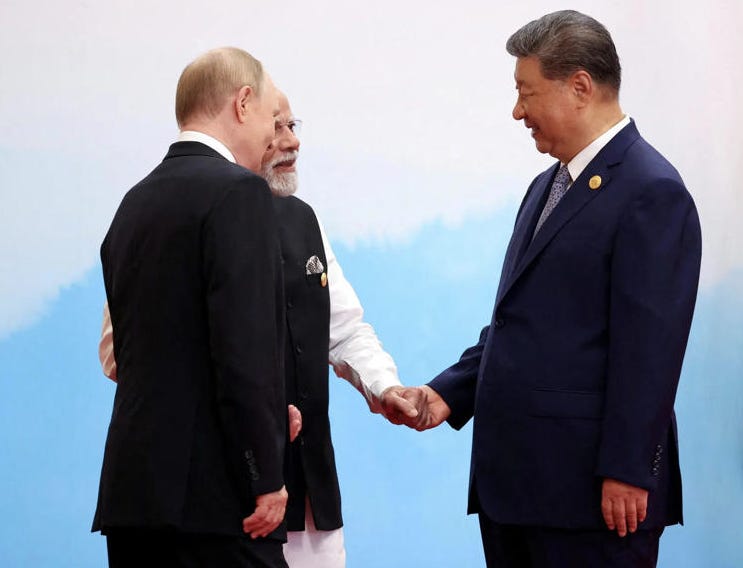
The importance of Trump meeting with Xi in South Korea at the end of next month (as a result of last week’s phone call) should not be dismissed, after all peaceful co-operation between the world’s two biggest economic and military powers is vital for all of us. However, nor should we ignore or dismiss the importance of this photo of Xi, Modi and Putin recently at the Shanghai Co-operation Organisation in Tianjin, pledging an atmosphere of peace and stability and to be partners not rivals.
It should have been celebrated in the west, but to the extent it was even mentioned it was deemed as ‘a threat’. There are of course sadly those who thrive on a lack of peace and stability and their voices are, in our view, over-represented in the discussions about China and the BRICS in general. However, there are also, genuine underlying competitive concerns about the economic challenge to the west from the rise of BRICS, with much being tried to undermine their coherence and emerging threat to the existing world order of western multinational corporations.
The key point for us is that China and the BRICS are building a whole separate Operating System (OS)
This competition is not just about trade with the west, but BRICS as a regional economic bloc. More than that, it is about an independent operating system. It is, in effect, the emergence of iOS to challenge DOS.
In Classical Economics, we look at the three factors of production as Land (resources) Labour and Capital. As our good friend Louis Gave of Gavekal points out, Russia has the resources, India now has the cheap Labour and China has all the money. This is a potent triple threat to the existing Globalist structures of the Washington Consensus and, as he says (and we obviously agree) investors need to consider whether their long term portfolios reflect the likelihood of their ‘winning’.
As investors we need to question both the motives and the veracity of much that we are told about the world outside ‘The West’’
Currently, to return to the importance of the Trump/Xi phone call, we also have China front and centre of the trade and tariff ‘war’ with the US and Xi’s talk with Trump will have raised both hope and concern about the future.
Undoubtedly they will have talked about Tik-Tok, which seems to have been co-opted by the US Tech bros, but also the irony that the very rare earths the US would need to build missiles for a kinetic war with China have to come from…China. This is reminiscent of the spoof meeting of the Australian government to discuss spending $30bn a year to protect their trade routes with China..from China. (see, Doesn’t this strike anyone in the room as odd?)

Likely they also talked about Russia and Ukraine, but importantly we suspect about the need for the US to dial down the rhetoric on China/Taiwan. As investors we have talked in the past about the push from some on the US side to declare China un-investable, basically over the issue of sanctions arriving from an ‘imminent invasion’ of Taiwan, noting the curious logic that would still lead the same investors to hold TSMC, Nvidia and Apple stock, all of whom would be in a whole lot of trouble should that actually happen.
It is perhaps also worth mentioning that, while 90% of investors couldn’t find Tianjin, where the SCO meeting was held, on a map (it is essentially the port region to the east of Beijing) it is the fifth largest city by population in China and has more people than the cities of New York, LA and Chicago combined.
Their spending power, skills and appetites are already a world away from those of 2015, when we last had a strong rally in the stock markets of China. And yet, we are constantly being told that everything is going to fail, just like last time. But it really is different this time, because now we have a new operating system for China and for the BRICS.
A new OS
The notion of a new operating system is analogous to the emergence of Apple to challenge the Microsoft world of the PC. Microsoft was famously suffering from producer capture, its products seemingly designed for and by ‘nerds’ and tech support having the RFM instruction (read the F’in manual). Steve Jobs produced something for the end user. The same could be said of the whole ‘western operating system’. It is seemingly for the benefit of producers, not consumers.
On this basis we need to see China as building a parallel product, not co-opting the western one. As a result, we think that the view The West has of China is akin to a value investor’s view of a tech company. The metrics they are using and the terminology they employ, we believe, represents a fundamental misunderstanding of what the ‘management of the tech company’ are trying to achieve.
China is Steve Jobs’ Apple, not Jack Welch’s GE
We have previously suggested that Trump is looking at the US like a businessman looking at a conglomerate that needs restructuring. By contrast, Xi is looking at China as a still rapidly developing country. It’s Jack Welch versus Steve Jobs.
Steve Jobs was not focussed on earnings per share, nor on paying a dividend. Rather, he was focussed on the company and its products. Get that right and the profitability will follow. Legendary value investor Warren Buffet has done extremely well out of Apple, running it from (all prices adjusted for stock splits) $35 to around $250, but he didn’t buy until 2016. For context, between 2003 and 2011 (when Jobs stepped down) it had already gone from 25 cents to $13.75.
We would argue that the same thinking applies to much of the analysis of China. The overwhelming majority of Economists and analysts are focussed on Western metrics like GDP, Inflation and Consumer spending and constantly ‘recommend’ policies to the Chinese authorities, (usually to goose up consumption by cutting interest rates) just as value investors would have recommended Steve Jobs pay a dividend and return capital to shareholders.
It’s not a nil-sum game
The west doesn’t have to collapse for China to grow (my YouTube feed appears equally balanced between those claiming China is doomed and those claiming the west is), but it doesn’t appear to have much growth. It can go sideways, while China and the BRICS do the growing, Investors looking for growth are starting to cotton on.
Here again the parallel with Apple is instructive.
Between the iPod and the iPhone, Nokia’s share price went nowhere, while Apple was 12x
When the iPod came out in 2001, Apple’s share price around 35 cents. At this point, Nokia was around Euro 22, having fallen from its dot-com bubble high of almost Euro 60, but was still a dominant force in the world of Telecom equipment. By the time Apple brought out the iPhone in 2007, its share price was $4.36 ( a 12 bagger), while Nokia was still around Euro 22.
Of course, Nokia has since gone down to around Euro 4, while Apple trades around $250, but we don’t need the firmer to be true to justify buying the latter.
China is building its own OS. For everything.
Also like Apple, China continues to build an independent infrastructure. Not only its own One Belt One Road infrastructure, but its own GPS system, its own energy infrastructure and its own aerospace industry. These are strategic goals, how this drops into the GDP numbers is as unimportant to the Chinese authorities as the impact of R&D spend on the iPhone was to Steve Jobs.
Meanwhile, as we noted (Questions and Answers Part 2), China is making rapid advances in developing its own energy infrastructure, particularly in alternative energy, both Fission and Fusion, and with wind and solar (still backed up by coal) is becoming increasingly energy independent.
The recent meeting in Beijing that saw progress on the Power of Siberia 2 pipeline was a reminder of the strategic importance of the One Belt One Road policy for China’s supply chain and its access to strategic raw materials.
Similarly, a focus on competition to increase supply of, say, EVs, is aimed at offering superior products at lower prices. The (western) notion that this is somehow a bad thing and that China needs to stimulate demand not only to mop up that supply but to push the prices higher obviously makes no sense - to China at least.
China will at some point become Tim Cook’s Apple, but right now it is still in Steve Jobs mode.
As we said this time last year, (see not a Bazzoka), the so called Bazooka stimulus was not because there was a housing crisis, it was to enable households and local authorities to access liquidity to clear the excess housing capacity. An excess that had arisen because the Chinese authorities had allowed the private sector to help provide a solution to an actual problem - the need to move 150m people from the countryside to the cities. The crisis, such as it was, lay with the housing developers, who had moved beyond supply and into speculation (as incidentally had/have many EV makers). The fact that many developers had raised billions from western banks and investors is probably why it was seen as a crisis.
Most important for western investors perhaps is that China is building its own operating system for its Financial Markets. This extends from the Shanghai Gold exchange placing the Rmb into the payments system for settling trade among the BRICS, to developments in stable coin and Panda Bonds, to the development of a domestic capital markets system to recycle domestic savings into investments.
A higher China Savings Rate represents a Work in Progress, not a steady state.
As with everything in China, the scale is huge. A case in point is the so-called Savings Ratio. There are multiple definitions of this, but if we work on Savings as % of net disposable income, we see China at between 30 and 35%. That is of a $20trn economy.
This compares to the UK at 10-11%, Europe at around 15% and the US at around 5%. This is not to say that China is ‘better’ and more thrifty, rather it is to identify the very different ‘balance sheet conditions’ and reinforce the point that expecting western policies to work in China is to misunderstand the(ir) bigger picture.
For a start, Chinese savings are (largely) focussed on Cash, Real Estate and Gold, whereas western rates are distorted by, in particular, Pension systems, both public and private. Culturally, China has more of a savings culture on the basis that the social safety net is less robust. This is something China is now addressing. We wrote about this in ( building a Capital Market with Chinese Characteristics)
Secondly, definitions of income do not always include the gains in personal investments. If your 401k has increased by 50% in the last 3 years, your need to ‘top it up’ with increased contributions is diminished. Similarly, if you work in the seemingly ever-expanding state sector in Europe or the UK and you have a defined benefit pension, your incentive to save more is low.
The aim of China, as we see it, is to copy the best of the US, Australian, Singaporean and HK systems, but avoid the worst. The process begins with putting a floor under Chinese Equities (done), shutting down speculation versus investment (ongoing) and rolling out state backed savings and investment schemes (underway).
If China is Apple, Europe doesn’t want to be Nokia, Japan doesn’t want to be Sony and the US doesn’t want to be Motorola. And Canada certainly doesn’t want to be Blackberry.
To round off the ‘China is Apple’ metaphor, if we move from Steve Jobs to Tim Cook, we will start to shift to more ‘conventional’ metrics, but we need to also recognise that by that point China will have locked a large part of the world into their OS and the winners will be those that can operate there and preferably in both systems.
(As ever, none of this should be considered investment advice. Please do your own research and speak to your financial advisor.)