
DRAMatic Price Moves
Another STAR rising in the east

The DRAM supply demand gap has brought forth an IPO for the fourth player, CXMT of China, whose share price jumped almost 500% at the opening on the Shanghai STAR 50 exchange today.
The biggest IPO in China since 2010, it was oversubscribed by 570x for the institutional portion and 244x for the retail side. For context, at an initial price of $1.28, that means Chinese retail had to lodge $1.2tn with the exchange. That is a lot of liquidity that will ultimately ‘stick’ in investment markets. Which is of course part of the long term plan to develop China’s capital markets.
Korean retail is currently ‘all in’ on Samsung and SK Hynix, while US retail has replaced Nvidia with Micron as their ‘top stock’. As such, they need to be aware of this new competitive threat. The money being raised is to help CXMT move into the leading edge High Band Memory (HBM) sector, which should raise risk premia on the big three.
Currently with a market share of 7.7%, estimates for its valuation depend on a market share gain as well as the current volume plus price super-cycle and current estimates range from 10-17%.
The dramatic ‘pop’ on day one of almost 5x also reveals the difference between IPOs to raise capital for expansion, where giving away a bit too much equity is not a big issue (and encourages retail participation) and IPOs where the principal aim is seemingly extracting as much money as possible for insiders.
It is also a further ‘nudge’ to international investors to take a proper look at the Chinese Star market 50 Index, which is where all these IPOs are heading.
The IPO of CXMT in China has attracted a lot of attention, not least because it soared 500% on its debut, with lots of questions over the Nomura report suggesting it could be worth Rmb7trn (around $1.2tn), i.e. 10 x as much as the IPO valuation. Lots of chat about how bad the investment banks were in pricing the IPO, but in our view this western-centric approach rather misses the point.
To us, it raises a different set of questions, most notably, what is the IPO there to achieve? In this case, it was to raise $8.5bn, which according to the FT was “to expand production as well as research and development of DRam (sic) chips, which store short-term memory in computers. It operates three DRam wafer factories in Beijing and Hefei and wrote in its IPO prospectus that it was “committed to continuously expanding production capacity and increasing its global market share”.
As such, ‘giving away’ more equity than you technically needed to in order to raise this money for Cap-Ex is very different to insiders ‘selling out for the maximum price possible’, which is the US model. The former leaves (more than a little) something for the next man, in obvious contrast to the latter approach, eg the Space X IPO, which was designed to shift risk from insiders to, basically, 401k investors, many of whom are currently sitting on a loss of between 25% and 45%.
If you want more IPOs to build your capital markets, it is better to leave insiders a bit short and early participants with a 25-40% gain, rather than the other way around
In terms of valuation, CXMT made over $7bn of revenue in q1 this year, around half of what Micron did in the same period and Micron is currently valued at $1tn market cap. This is similar to the target market cap number reached by Nomura for CXMT, which has attracted headlines with a valuation that implies a 13x gain from the IPO price and a market cap of around Rmb7.8trn. Meanwhile Northeast securities have an upper end estimate of around half of that. The details can be found in a useful discussion here.
In essence, the different valuations rest on a combination of the chip cycle and market share, where both research houses suggest that CXMT can overtake US retail favourite Micron.
The fact that CXMT says it can have 350,000 capacity by the end of next year, almost as much as Micron, should not be under-estimated for either company.
Chip companies are notoriously cyclical, that is why they trade on apparently much lower valuations than, say, software companies. Micron revenue was twice as much as CXMT in q1 2026, but also twice as much as its own revenue from a year ago. Meanwhile, CXMT revenue was 7x that of a year earlier, driven largely by the cycle - both operational gearing and pricing.
In terms of market share, CXMT is definitely the fourth player in the chip sector at the moment, with an estimated $50bn of annual revenue, close to Micron’s current forecast quarterly level, but, as with so much technology, the western companies are losing the huge Chinese market to domestic suppliers. Over the last two years, Micron’s revenue in China has halved, while CXMT’s domestic capacity expanded from 90,000 to 260,000 a month and, as the IPO prospectus highlights, it is on track to draw level with Micron next year.
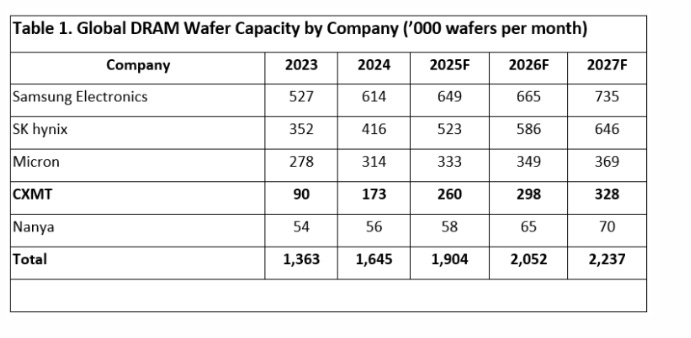
As was pointed out in this article, poignantly titled, CXMT is eating Micron’s lunch in China, leading edge parity in technology is not required to drive domestic substitution in China, but the article also notes that a key part of the reason for the IPO is to fund R&D into getting closer to that frontier, which is where the competitive threat starts to rise.
CXMT is not currently at the leading edge, but the capital from the IPO is to aiming to change that. And with it, the competitive threat to the big 3
This is not to say that CXMT are about to flood the international markets with competitor chips, rather that is is an important player in the global market and likely to dominate Chinese supply while indirectly affecting global prices. In particular, with Apple rumoured to be considering using CXMT chips, the pricing power for the whole group is inevitably going to come under pressure.
With the usual Caveat that this is not investment advice (please do your own research and always speak to your financial advisor), investors who have enjoyed the ride in the Chip stocks should think about some parallels with other industries.
CXMT’s origins lie in the purchase of patents from a German company called Qimonda, that went bust in the GFC, along with access to its China based R&D centre in Xi’an. Just like the car industry, it recruited key western engineers and returning Chinese and built on that original legacy. Also like the car industry, it benefited from the VC approach of Chinese local government, which is very different from the catch all complaint of ‘subsidies’. In this case Hefei province, which had successfully nurtured both BOE the world’s leading display panel maker and NIO, a leading EV maker, helped assemble the local supply chain around CXMT. There is a great description of the process as well as a proper deep dive on the company to be found here.
The bottom line is that returns in (primarily US) stock markets have been running at double or more long term averages, at least in part because quasi monopoly status and high margins in US tech, combined with share buybacks and other balance sheet manoeuvres have delivered 20% plus EPS growth. Software companies and the MAG7 have, rightly, sold off this year as AI challenges those quasi monopoly moats, allowing tech hardware companies to become the new darlings as the Cap Ex from the hyperscalers feeds straight through to the bottom line of the Chip makers selling the picks and shovels to this particular gold rush.
Swapping structural winners for cyclical ones means shifting valuation models
However, these are very different beasts, operational gearing is huge and so is pricing power when Demand exceeds supply. But they are also (brutally) cyclical and symmetrical. The arrival of a new supplier from China, one with a powerful state backer is a reminder that, ironically perhaps, the biggest source of capitalist creative destruction is currently the People’s Republic of China