
Hydration Break
A need for liquidity....Market Thinking July

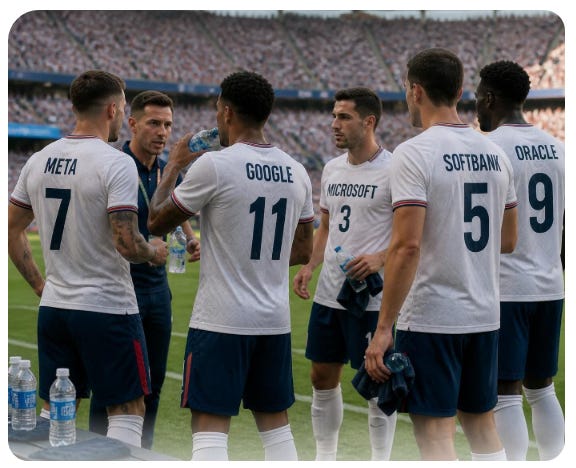
Gary Lineker famously quipped that football was a game of two halves..and then Germany win. Well obviously that hasn’t aged well, as not only are Germany out of the World Cup (and dropped from number 1 in the world in 2018 to number 12 now) but also, with FIFA’s latest changes and ‘hydration breaks’ football is basically now a game of four quarters. And FIFA win.
Like the football, the market seems to be more heavily focussed on this being the end of the second quarter of the year, rather than the end of the first half, with profit taking and rotation into the quarter end and, seemingly a lot of traders closing books for the summer. And like FIFA, it is also focussed on liquidity.
June itself was also split in two, the first half, into the Space X IPO, was full of liquidity and upward momentum, while the second half has seen momentum stall, lower liquidity, profit taking and an interesting battle between Korean Retail and US institutions over the Korean Tech hardware stocks, which have gyrated wildly within a widening band.
There was also the ‘peace deal’ on Iran, that led to some selling in energy related stocks and profit taking in cyclicals, even though the demand/supply imbalance remains extremely favourable. It has been our contention that the market was already looking through to a post war period and, callous as it sounds, only really ever cared about the Strait of Hormuz. As such, they don’t really care if the underlying conflict is not really ‘solved’, so long as the supply chain restrictions are lifted.
Meanwhile, the huge hype about AI into the IPO had already reached a level of saturation required to pull in the buyer of last resort - US retail - leaving them to deliver the price discovery as insiders got out and, as the hype has subsided, the subsequent drop from the first day ‘pop’ has re-ignited concerns about the huge cash burn and liquidity drain of the AI build out (see Silicon Valley Liquidity sponge).
There was also however, a third big event, one that would normally have attracted a lot more attention, which was the first meeting of the new Chairman of the Fed, Kevin Warsh, who removed forward guidance and re-emphasised price stability, causing the fixed income markets to flip from expecting rate cuts to now expecting a September rate hike. This in turn led to a rally in the $ and a sell off in long duration assets, particularly some of the big growth stocks.
With the AI hype faltering, bonds worrying about inflation and a need for post war liquidity, equity markets continue to feel quite fragile, not least as leveraged single stock options are being hedged with leveraged inverse ETFs making for some huge volatility beneath the surface.
The need for liquidity is likely a factor behind the weakness in gold, but the drama once again unfolding in so called digital gold, bitcoin, is more structural in our opinion. Its recent weakness was undoubtedly affected by the decision by the long term under-bidder for Bitcoin, Michael Saylor’s Strategy, to turn seller, even of only a small amount of Bitcoin, in order to pay a dividend on its convertible, which took away a major prop to the price.
Is Trump promising to save Michael Saylor and Bitcoin? Or is that Larry Ellison?
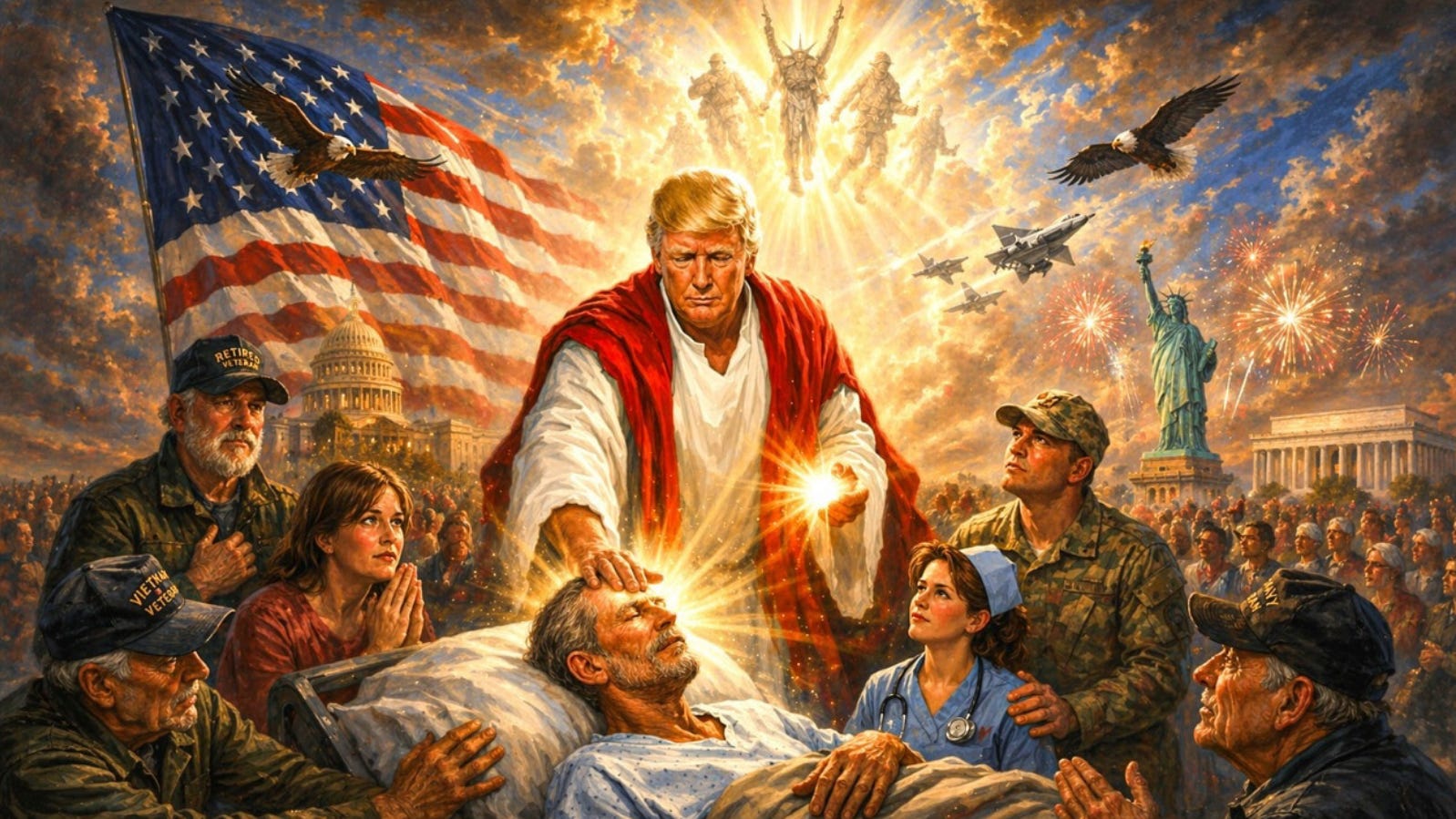
Perhaps Donald Trump was offering to save Michael Saylor in his famous AI generated picture? It certainly looks like him. And it’s certainly a growing question of who else will do so other than the US Government. The price has broken down through $60,000 and is threatening the 2024 support levels around $54,000, below which is, not very much.
However, the bigger problem as we see it, and which we discussed back in December (see Untethered from Reality), is the emergence of stablecoins as a preferred instrument for transactions - one backed by many governments - which has seriously challenged a key part of the use case for Bitcoin, together with the fact that the US government has seized upwards of $30bn of Bitcoin (and is not a strategic holder) also significantly undermines the ‘scarcity’ angle.
Stablecoin can grow if government doesn’t stop it. They are not savings instruments , they are a transactional solution, removing frictions from the system. Bitcoin looks to be the opposite, it wants to be an investment, but that removes the transactional use case, while the volatility continues to undermine the investment case.
Or, perhaps Trump is saving Larry Ellison? After concerns that Open AI may delay its IPO, there are obvious questions around Oracle, for whom they will be one of its biggest customers and after a powerful counter-trend rally in May and June, the stock is back down close to its year lows and off heavily (34%) since the start of the year. But then so is Microsoft, which owns a stake in Open AI, (down 18% on the month) as was another major stakeholder, Softbank, which was 20% down.
The recognition that the AI boom may be destroying shareholder value hasn’t come to the big Tech stocks quite yet, but remains the biggest threat to US markets
The tech hardware companies all continued to thrive, but we should not forget that everything connects. If the Hyperscalers call even a modest Hydration break in H2, the rush for the doors in the tech hardware stocks could become a stampede.
During the second quarter, the dollar has rallied against, Gold, Bitcoin, the Yen and the Euro, but interestingly not against the Yuan, which is currently at the bottom of the range since late 2022. We still suspect some deal is to be done here, even if Iran is back to selling Oil in US$. More important perhaps is that China is selling Open Source AI for a fraction of what the big, pre-IPO US companies are, which raises serious questions about the total addressable market. If it’s winner takes all who’s to say it won’t be China? Perhaps Trump needs to save Sam Altman too?
Short Term Uncertainties - leverage and liquidity
The level of volatility on the surface may be modest, but below the surface it is significant. As we noted (in where are the customers yachts) the volatility on the Nasdaq is much higher, as are implied volatilities on a number of ETFs and of course on the Korean Index, the KOPSI, which is really a tech hardware play.
Part of the problem is a massive growth in use of leveraged ETFs, mostly as ‘hedges’ against single stock options. As the chart from Zero Hedge shows, this is leading to a dramatic rise in Gamma as the dealers are trying to ‘hedge the hedges’. So instead of selling when others are buying, they are buying too. And selling when others are selling.
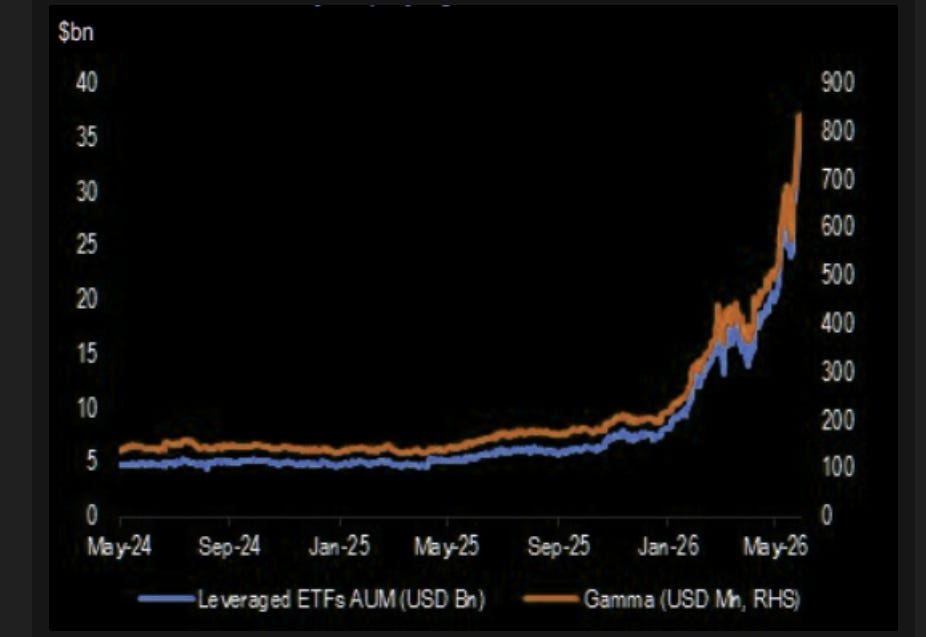
This is creating a see sawing effect of large daily moves in both directions.
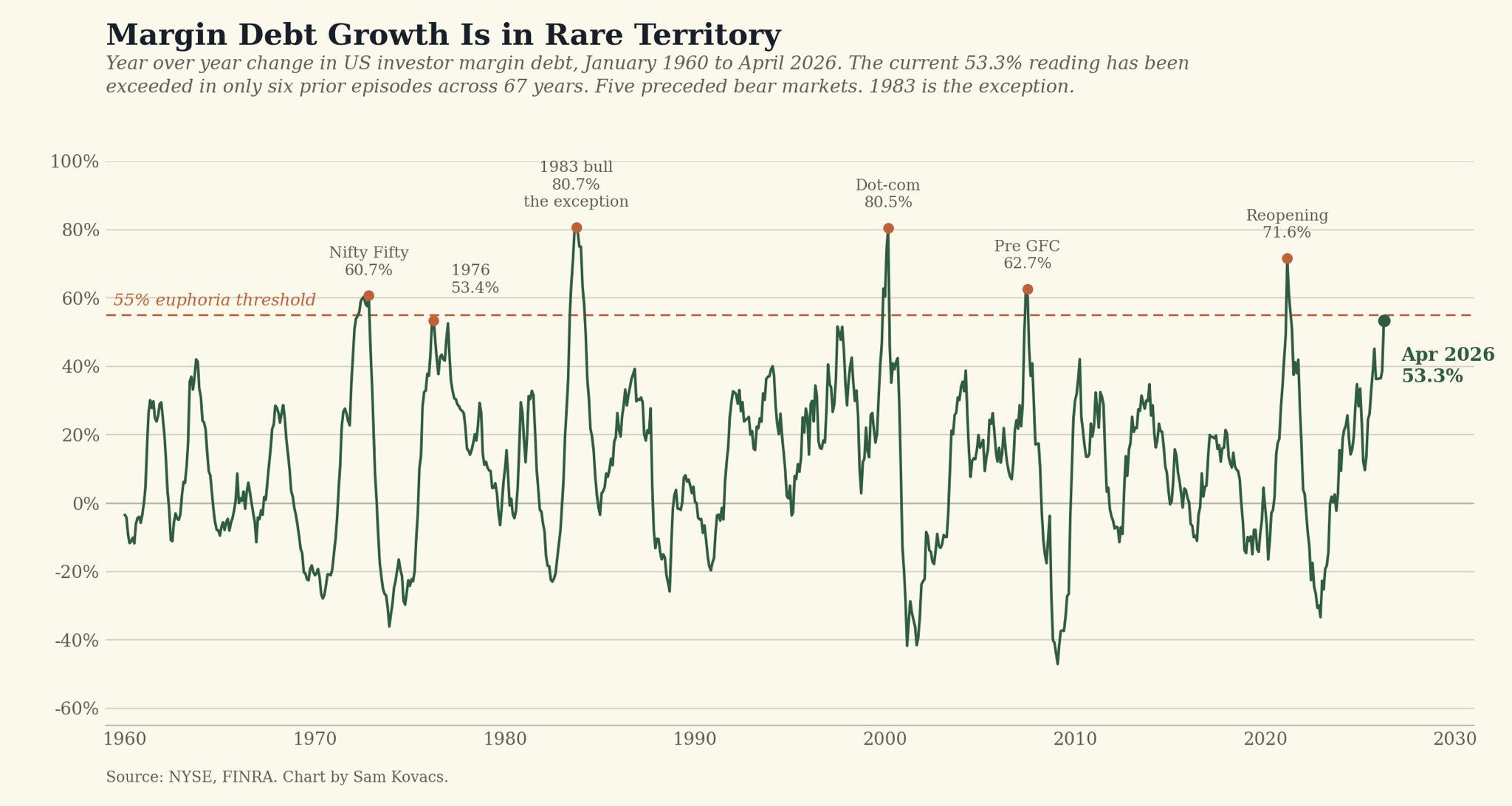
Leverage is increasing elsewhere too, and it is the rate of growth in margin debt that should be of concern. Here we can see the growth in margin debt is at levels not seen unless we are heading for a significant air pocket.
Meanwhile, we see that , after the underwritten ‘pop’ in the first two days, the Space X share price traded back to essentially its IPO price, with some support perhaps appearing ahead of the NASDAQ inclusion next week. We note that the AI generated comment on the stock on Yahoo Finance says the following:
SpaceX is set to join the Nasdaq-100 on July 7, prompting significant passive investment inflows. However, analysts caution that the stock may not be a buy due to its premium valuation and upcoming challenges.
AI generated text on Yahoo Finance about AI (not Space) company Space X
This may well mark the top in this iteration of the AI bubble, with suggestions that Sam Altman will delay the Open AI IPO until next year, while Dario Amodei at Anthropic is probably starting to question the wisdom of a marketing strategy that pumps up your pre-IPO price by telling the government how scary and powerful your model is and then leaves you stranded when the Commerce Department agrees with you and bans it. Not allowing any of your own foreign born staff to use your models certainly limits your total addressable market.
Medium Term Risks - Return on Investment in AI
We remain concerned that the amount of capital being committed by the hyper scalers is out of proportion to the prospective returns currently embedded in their share prices. To quote David Cameron at Tony Blair “you were the future once”, these companies got to be the biggest in history by running on rails that others had built. Now they have to build the next set of rails.
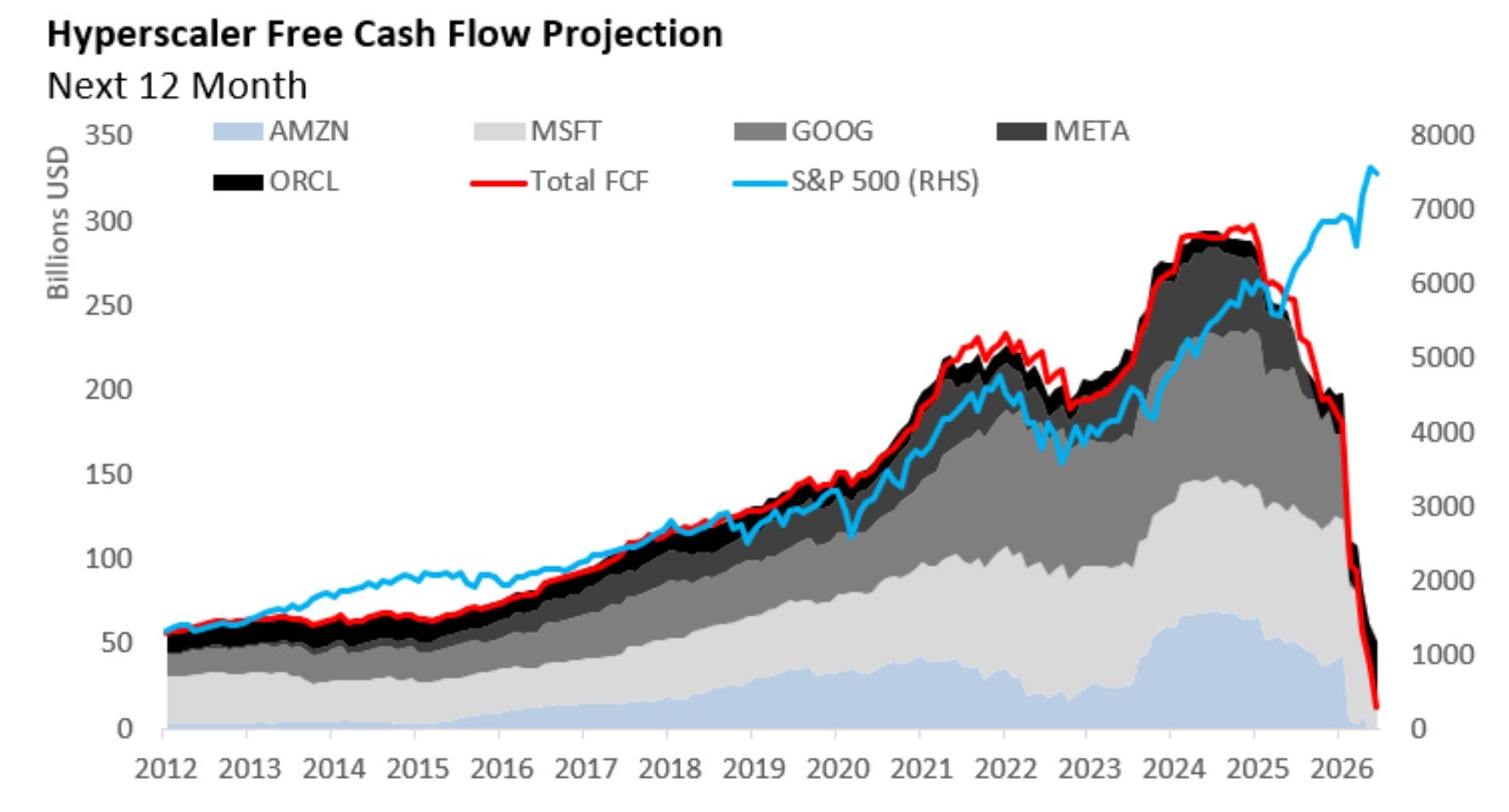
A switch from a free cash flow positive, asset light business able to buy back hundreds of billions of dollars of its own shares and grow by acquisition using their inflated share prices, to a cash flow negative, asset heavy business needing to issue both equity and debt to build the infrastructure on which currently cash flow negative start ups are promising to pay them to use. And lending them money to do so.
Indeed, the first of the big AI firms to raise equity capital, Space X, may well have cornered all the available cash and the insiders in Open AI and Anthropic must be feeling somewhat nervous that the US public might not agree on their epic valuation metrics.
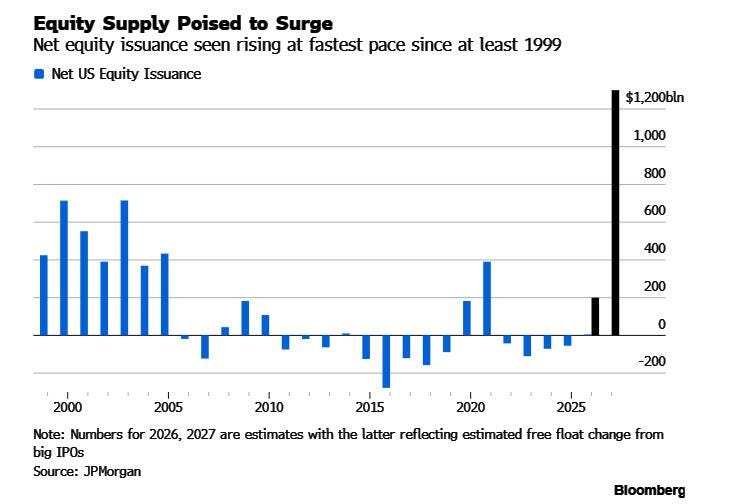
Already we have seen the MAG 7actually down year to date as the rest of the market is up, dented by the recognition that most are about to turn cash flow negative. Certainly, the traders have switched aggressively into the tech hardware stocks as selling the proverbial picks and shovels into a tight market, but the worry for the rest of the eco-system has to be that, possibly as part of a stand-off with the US government, the hugely economically and politically influential hyper-scalers start to talk about scaling back on AI infrastructure spend. The first whiff of that would leave the current real bubble in tech hardware stocks looking very vulnerable.
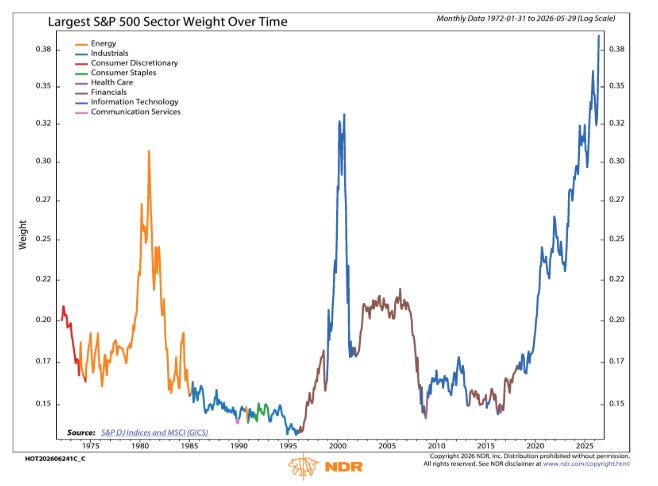
This would obviously be very bad news for the S&P500 market cap weighted index, where IT is now the biggest ever single sector weight and June once again saw a significant outperformance by the equal weighted rather than market cap weighted S&P500 index.
Long Term Trends - policy induced stagflation
The resignation of yet another UK Prime Minister is reducing the UK to the level of political ridicule that used to be directed at Italy. It is interesting to note that, by September this year, Georgia Meloni will have been the longest serving PM for the post war era -although many served multiple terms. Perhaps that is Tony Blair’s plan?
Governments push up wage costs, including their own, which pass through as higher prices and lower profits and greater index-linked government spending. They also push up energy costs through net zero policies. Then central banks push up the cost of existing debt and the cost of new investment.
Economically, the real issue in the west is not the person, it is the structure. Fiscally incontinent governments are partially kept in check by notionally independent central banks, but in may cases they too have fallen for a dogma of their own. Thus, globalist, social democrat governments in UK, Europe, Canada and Australia all, variously, impose cripplingly high minimum wages in a virtue signalling fashion, only to find that they create not only youth unemployment but also cost push inflation and extreme pressure on operating margins for many businesses. Similarly, the cross border consensus in all these countries for ruinously high energy prices in line with UN strictures on Climate Change is having a similar economically deleterious effect.
And the response of the central banks? The same as it would be if the governments were cutting taxes or boosting demand by simply pumping money into the system, they raise interest rates. The ECB has just done so and the US is now expected to. Keynes once said that “Practical men, who believe themselves to be quite exempt from any intellectual influences, are usually the slaves of some defunct economist” but so too are economists. The idea that the best response to rising costs that are crippling demand is to increase some other costs in order to so cripple demand as to lower inflation via depression is crazy. But seemingly policy.
With the usual caveats that this should not be considered investment advice (do your own research and speak to your financial advisor), the current situation makes us nervous and we would not be chasing hardware stocks from here, nor trying to bottom fish in, allegedly oversold, Mag 7 stocks. Diversification, by sector, by theme and by country, offers the best risk management, as does a focus on the medium and long term. Short term volatility is the enemy of the trader rather than the investor and the best advice may be to go to the beach, turn off the screens and Re-Hydrate.