
Year ahead
Thinking about things....and the narrative of things

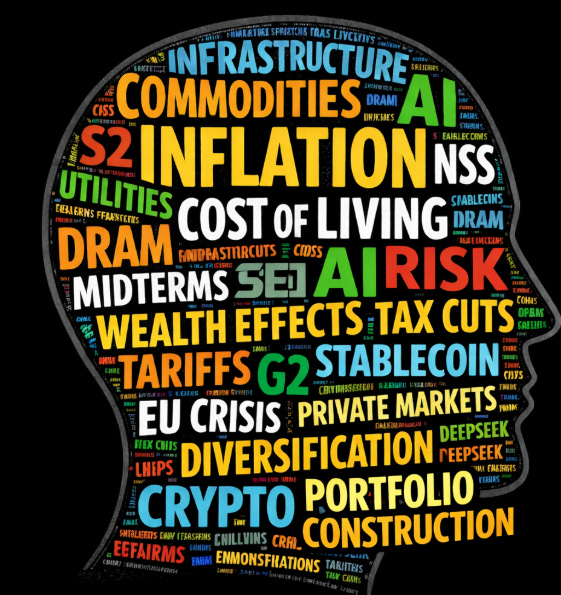
This time of year, the internet is full of predictions for the year ahead, (this year mostly seemingly written by AI) along with reviews of the success, or otherwise of predictions from the previous year. In practical terms our job as investors is not so much to predict, as to prepare to adapt - so the purpose of this year’s exercise is as much as a framework for a discussion as anything else.
We are not deliberately contrarian, but to generate returns we need to look for things that are not currently in prices. As Keynes put it, “When the facts change, I change my opinion, what Sir do you do?” Hence why we are always looking for obscure (or often obscured) facts and data to challenge the consensus.
Our aim is not to persuade readers to our opinion, but rather to present the facts and analysis that lead there. If we can introduce (or emphasise) facts that might not be widely known or discussed then we can hopefully add value.
So, in no particular order (and with the usual caveat that this is not investment advice).
US Midterms. It’s amazing to think that Trump 2.0 is only a year old (see welcome to MAGA Vision) but rather than focus on what has changed, which is a lot, we suspect that most US Media will talk about little else other than the Midterms this year and we already see the Democrat talking points being rehearsed across the mainstream media.
With no real leadership or positive policy initiatives, they are going for a reboot of Clinton’s attack on Bush senior that “it’s the economy stupid“ and manufacturing the narrative that there is a cost of living crisis. This is being presented as ‘an attack on the Middle Class’, but the focus on affordability suggests it has a lot more in common with the success of socialist Mamdani in New York.
Ironically, it was ignoring the cost of living crisis/pretending it wasn’t happening that undid the Biden/Harris campaign, so pretending it only started under Trump is a nimble pivot. However, while the Dems get excited about defeating Trump and markets start believing in a return of the Ancien Regime in three years time, we suspect that Team Trump will counter with policies like tax cuts that will flip this narrative around.
As previously noted, the soft data on opinion polls is so heavily politically biased such that you can make any narrative you wish, but the narrative of a weak economy will also be pushed by Bond market bulls this year. A year ago, the 10 year was around 4.6% and we thought it had room to go below 4%. Now at 4.1%, not only are interest rates (and thus financing) lower across the whole front of the curve, but there is less tactical upside.
We would thus challenge the bond bulls, not least because;
Inflation. The big market story for this year in our view is going to be upside surprise on inflation, particularly in the US. This has less to do with tariffs (q.v.) than with old fashioned Demand > Supply and the cascade of liquidity from decades of QE that had remained largely within the Financial Markets, but which now, thanks to the AI Capex boom, is coming into the real economy.
At the same time we see a shift in the China deflationary impact, from everyday items in Walmart, to larger items such as autos and competing demand for raw materials and the ongoing impact of the ironically named Inflation Reduction Act which was a massive fiscal stimulus by another name.
We are already starting to see this not just in pinch points like rare earths, but in commodity prices and industrial metals, reminiscent of the impacts of the cap-ex boom in China in the early 2000s.
Wealth Effects and Medians versus means. The rolling impact of the post Covid gains in financial markets and the explosion in Crypto have enhanced bi-furcation in western society. The Gen Z in New York elected Mamdami because it is crazily expensive to live there, but Manhattan alone has 389,000 millionaires and 129 billionaires as well as their offspring driving up prices at the same time as more than 20% are living on welfare.
This is true of many large cities in the US and also Europe and is behind ongoing social tensions and populist politicians. Large amounts of government ‘stimulus’, including the hundreds of billions going into Ukraine and the defence industry, are leaking into the real economies and causing asset bubbles everywhere.
This leads to some very distorted ‘statistics’. For example, while the US has the highest wealth per capita on average after Switzerland according to the latest UBS wealth report, when it comes to the Median, it is number 15, below Italy, France and the UK. We made this point in a recent post, where we highlighted that when Elon Musk walks into the SuperBowl stadium the average wealth of the audience jumps by $8.3m.
In particular, this bi-furcation threatens institutions that rely on homogeneity, like the EU, especially as unelected bureaucrats are claiming to speak (and act) on behalf of 500m people. Which is why:
European Financial Crisis Redux. The problems exposed in the aftermath of the financial crisis have not gone away and an ideal monetary policy mix that works for both core and periphery remains elusive. However, a combination of Covid linked fiscal expansion (and associated debt to GDP issues) and the self destructive energy policies associated with net zero have pushed Europe and the UK into a stagflationary crisis. China is eating Germany’s lunch in the industrial sector, while Europe has singularly failed to develop any meaningful tech industry to compete with the Americans, who now have the advantage of having woken from an Alice in Wonderland Fever Dream that the UK and Europe still inhabit.
We would not be as bold as Yanis Veroufakis on the outlook for Europe and the EU, but his analysis bears due consideration.
The comparative response to AI has been instructive; the US is deregulating, while the EU is, once again, over-regulating and as Mario Draghi pointed out in his review, the aspirations of Brussels to be ‘a regulatory superpower’ are crippling the economy.
Investors looking to diversify from the US have naturally landed on Europe, but the outlook for profitability here is patchy and doesn’t offer the restructuring stories that have helped Japan and Korea for example. European financials have been a great play for the post Covid period, largely due to what they didn’t do (lend in the prior decade) than what they did. Now, we wonder if a better way to play an over-regulated environment is through the high (ish) yielding utility sector.
Tariffs and tax cuts. The liberation day tariffs in April triggered a panic (now largely forgotten) in what were, admittedly, overleveraged equity markets, but as we pointed out at the time in on of our most popular posts (It’s not a cock-up, it is a conspiracy) most economists and advisors missed the point that this was a deliberate policy shift, targeting Davos man and the Global Corporates that have been winners under the US post war economic model.
With the caveat that we need to watch what he does, not what he says, the interesting thing about the US Tariffs in our view is not that they are inflationary per se, a one off price hike is very different than, say, an annual uplift in the minimum wage, something that attracted a lot less criticism from the economic profession, but the impact they might have by enabling tax cuts.
Team Trump have pointed out that $600bn of tariffs (which is well in sight) could pay for a reduction in Federal Income tax for 90% of US tax payers, to zero. It might not happen of course, but the idea is out there and it would be a very powerful tactic for the mid terms (q.v.)
Such a stimulus would be very different than the wealth effects from the stock markets and crypto, perhaps more akin to the Covid transfers, although as tax cuts they would obviously only benefit tax payers. More important, in securing the blue collar, Joe Rogan listening, vote and ignoring the white collar administrative and media class MSNBC watching vote, team Trump are shifting the profitability model for the US economy - and the market.
An important and controversial addendum to this is the concept that the US Elite is now split into a civil war of sorts. As the excellent Pippa Malmgrem explains on her (imho must read) substack, the two sides she refers to as the Populists and the Custodians have a radically different take on almost everything, from Ukraine to Healthcare to Media representation and all else in between. To be aware of both sides is to be prepared for shifts in the accepted narrative.
Diversification and China. This of course was our story for 2024 and 2025, but it is only getting stronger. The emergence of China’s EV industry has hammered home the competitive advantage of a cheap energy policy combined with centrally directed investment to support key industries. This should not be a surprise to anyone following the series of 5 year plans, but somehow seems to be, perhaps because most western economists keep expecting China to follow the western economic model instead of the Chinese one.
The 2015 pivot to Asia evolved into an all out economic attack on the China supply chain through a series of sanctions that have backfired spectacularly as China responded by de-westernising its supply chain, just as it de-westernised its financial markets after 2009. The last link was arguably helium (link) and now it has independence there, China has now countered with its own sanctions on items like rare earths.
China also shocked the world in 2025 with the emergence of Deepseek in February and later in the year a series of IPOs for Chip stocks like Moore Threads that not only challenged the (rather complacent) western sense of technical superiority in these areas, but destroyed any notion of western companies being able to sell their products into a ‘hungry Chinese market’ at premium prices.
The US now faces a dilemma; if it tries to de-orientalise its supply chains, then the prospects for US markets and indeed the economy in the short term are not great, just as they weren’t for Chinese households and investors while they de-westernised, but if it doesn’t, then the EV effect will spread.
The optimal outcome - which we see as more likely than most - is a rapprochement of sorts and the notion of G2 becoming more accepted. The publication of the US National Security Strategy for 2025 is required reading for anyone looking to understand the current thinking of the Trump Administration. Not what experts and lobbyists think they should do, but what they say they are going to do. Basically this boils down to backing away from Ukraine (and leaving it to Europe) and backing down from conflict with China.
Neither policy really seems to be in consensus at the moment - probably because of the dominance of the Custodians mentioned earlier (who oppose such policies) in setting narrative - which is exactly why we need to be aware of the counter-narrative.
Private Markets. The IPOs of Moore Threads et al are a strong signal to us that the Chinese authorities are wanting to encourage greater savings and thus investment in public capital markets. Meanwhile, Wall Street is targeting the established savings institutions and retail to participate in Private markets. This is not going to end well in our view, although in the meantime it will likely be great for the Private Equity groups like Blackstone and Carlyle.
At the same time as the US is going more private, China is going more public, which will increase the opportunity for international investors to participate in the profitability of the Chinese economy. It won’t be the monopoly tech profits they are used to in the US, but it will offer the full spectrum of factors, from quality to size to value to growth - along of course with characteristics like momentum and minimum volatility. Indeed, a barbell G2 Portfolio could look very interesting!
Crypto and Stablecoin. The Crypto crash in Q4 has left Bitcoin down on the year, although it hasn’t yet put too much of a dent in the Bitcoin Wealth effect, as it is still double what it was 5 years ago. However, as we wrote in ‘Untethered from reality’, we think that the official sanctioning of stable coins like Tether has raised serious questions about the concept of crypto as money and also as an asset class. The idea that Crypto is limited in supply and thus has scarcity value is obviously undermined by the ability of companies like Tether to simply issue stablecoin backed by US Treasuries and thus take the utility role from Bitcoin et al as digital cash, leaving them as a form of digital gold but not much else.
Meanwhile, the idea that the huge institutional market will buy Bitcoin as an asset class, also in the manner of digital gold, is being challenged by the reality of volatility levels around 65%. A system that continues to see Equities as risky with volatility below 20% is not going to easily embrace Crypto.
AI and Robotics. Disruption coming. AI has dominated the market chat for much of 2025 more as a concept than a reality, particularly the statements from the PT Barnum of our age that is Sam Altman. However, things are now getting real and markets are worrying about who is going to pay for it all (hint, it won’t be the billionaire class in the new Zaibatsu.)
The build out of datacentres is real and, as noted earlier, inflationary, but also energy hungry and is already triggering innovations in chip design and processing that could leave incumbents stranded. Think how the internet was seen as being all about Cisco and mobiles all about Nokia. Until it wasn’t.
Deepseek was a warning shot and firms like Microsoft, Amazon and Perplexity as well as many US startups are using Chinese open source AI rather than find themselves locked into the US for profit AI ecosystem.
The innovations kept coming throughout the year (see here, The Year AI got Real for a good discussion) with November producing some dramatic leaps in models - and some disruption to the Mag 7 as Nvidia fell 11% over the month while Google (thanks to Gemini 3) rose 11%. This is bringing stock specific risk back into markets.
Memory is now in short supply and the prices of DRAM have exploded as the new picks and shovels. Samsung and SK Hynix shares have soared, along with Micron. Cheap memory has gone as a commodity.
Much is made of the disruption to jobs, but equally the increase in efficiency and effectiveness offers significant potential profitability gains for some, notably the integration into robotics and potential breakthroughs in Healthcare and biotechnology.
Portfolio Construction. Last but not least is the notion of Portfolio Construction and Risk, since this is ultimately where the previous discussions lead us as investors. Diversification means not only by Geography - incorporating Global Themes - but by Sector and Factor. AI and Tech growth are important, but more nuanced and no longer MAG7, while Value is still available in cyclical stocks in old commodities and new ( as we saw with DRAM).
Chinese IPOs look more interesting than the Mega US ones lined up, while Europe and the UK need meaningful policy change on Energy and de-regulation to achieve any real growth. The excess of Demand over Supply is likely to create a secular inflation pressure that means fixed income, having firmly ended its bull run is now in danger of heading into a bear market. This will help demand for Quality and higher yielding equities, especially if they are index linked - as many are in UK and Europe, but also Asia.
The existing default of market cap based and momentum driven strategies of passive investment in the major (US dominated) indices risks a lost decade while other strategies - eg Value, Quality, Emerging Markets, Asia and thematics offer a combination of diversification and focus.
Meanwhile, the next stage of ‘financialisation’, shifting Private Market portfolios into continuation funds and onto the Retail Investor, raises issues for Diversified High Net Worth Portfolios, where the prospect of a liquidity effect will lead to a reallocation back to liquid alternatives. How these are balanced and constructed will be a key focus for us - and many others - in 2026.
I agree Yanis is definitely worth listening to even if he is a bit.. alarmist! But yes I'm looking at South East Asia at the moment for some diversification. Thanks again for the post!