
Thanks for the Memory..
Mean (reverting) Markets. August Market Thinking

July was a month of market mean reversion; stocks that were up more than 100% in the first half, fell back an average of 25% in July, while stocks that were down more than 50% rallied by an average of 11%. In most cases, this still left the longer term themes intact, but for those who live and die by monthly returns it is fair to say it was a tough month.
The biggest hits came in the crowded tech hardware stocks, where we discovered at the end of the month one particularly large and heavily leveraged fund was forced into a dramatic unwind. Not unconnected, over 1 million S. Korean retail investors apparently received margin calls on positions in the two big Korean memory stocks - Samsung and S K Hynix - the latter having just launched an ADR.
The two Korean giants dominate not just the Kopsi, but a number of regional ETFs like the Asia 50 and even the Emerging Markets ETFs. As such, their stock specific technicals have tended to create false messages for the markets about some of the more traditional macro trends. For longer term investors it remains important to stay focussed on the underlying signals rather than be distracted by the noise.
Otherwise, a lot of the rotation was likely down to traders closing their books and heading for the beach, but there were also constraints on liquidity from the Space X IPO back in June and the general soaking up of liquidity by Silicon Valley giants previously throwing off cash flows.
Meanwhile, oil was up above $100, then down $12 and then back up again as the on/off switch on war in Iran flicked up and down and the bond markets appeared to give up trying to price it in terms of inflation - just as the Fed gave up giving forward guidance.
August is traditionally low on liquidity but high on noise and volatility and there is no reason to suspect this year will be any different. Time on the beach though to consider the bigger competitive trends emerging - from AI as a business more than a job disruptor to a China’s IPO conveyor throwing up global competitors all up the value chain. Meanwhile, we would not rule out an Autumn currency accord between Japan, the US and China.
As usual, none of this should be considered investment advice. Please do your own research and always consult your financial advisor.
Short Term Uncertainties - Price Driven Narratives
Sometimes narratives drives markets and sometime price movements drive narratives. July was the latter sort of month. The sell off in the chip sector, while heavily technical and connected with, inter alia, profit taking, margin calls (especially for Korean retail investors) and closing out of the large hedge fund bet of long tech hardware/short tech software, has led to a (rightful) questioning of the risks to the AI build out. The previous certainty - encouraged of course by the hype around the Space X IPO - gave way to uncertainty.
We noted last month that “we would not be chasing hardware stocks from here, nor trying to bottom fish in, allegedly oversold, Mag 7 stocks” and nor did we, because we are not traders. But plenty did.
SK Hynix raised $26.5bn in the US in early July, the largest foreign IPO in history, but which briefly dropped 15% before month end as the market turmoil hit memory stocks. The company is also actively trying to lock in 5 year contracts, both actions suggesting that they see this as the top of a cycle. When the stock fell 20% despite posting a 600% increase in profits, retail money started to notice - not least as more than 1 million Korean retail investors were reportedly hit with margin calls. This in turn has shifted the narrative to one where. maybe, not all those AI datacentres are actually going to be built. Or are actually needed.
SK Hynix aren’t calling Fire in a crowded cinema, but they are definitely edging towards the Fire escape.
It is also raising some interesting questions about market earnings and valuations. Tech hardware stocks are very cyclical and 600% increases are obviously not sustainable. But at least there is real cash being generated. Contrast that with earnings announcements from Google and Microsoft - both of whom wrote up the value of their investments in pre-IPO AI companies Anthropic and Open AI as ‘investment income’. Along with every VC in town they are counting their metaphorical chickens before they are hatched.
‘Investment Income’ for hyper-scalers from higher marks to private valuations in Open AI and Anthropic are ignored at the stock level, but may be distorting Index EPS…and hence valuations
At the stock level, these ‘higher earnings’ were given relatively short shrift, but we suspect that, at the macro level people are merely seeing index EPS higher, but prices lower and are viewing this as ‘good value’. Just as not all GDP is equal, so not all EPS are.
Red Run
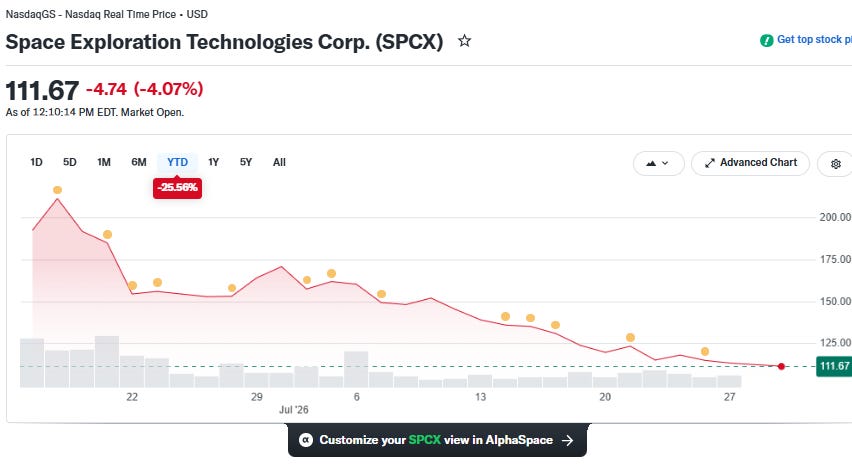
Part of the concern over the ‘investment income’ stems from the ‘failure’ of the Space X IPO and the risk that US retail ‘won’t be fooled again’. The downhill ride from the day 2 peak in Space X now exceeds 50% and 30% from the day it went into NASDAQ. Price discovery can be painful. As we noted in the contrasting IPO for CXMT in China in mid July, an IPO like Space X, designed to get insiders out at the highest price at the expense of the next buyer is not going to help the overall system. The next one or two big IPOs are going to have to leave more on the table ‘for the next man’.
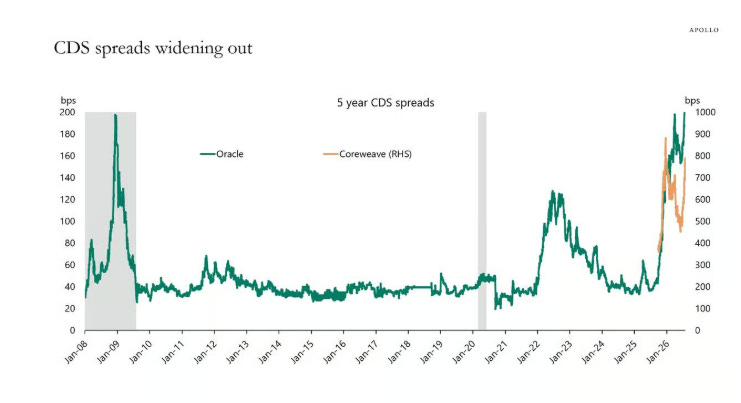
Meanwhile, the CDS Canaries are still chirping. The chart below shows the Credit Default Swap spreads for two of the most vulnerable players in the AI build out - both heavily dependent on Open AI and the circular financing story. Back in 2008, it was the CDS spreads that gave the warnings (and made the money for the traders who called the crash).
Coreweave, incidentally, was at the heart of the over-leveraged strategy for the Hedge Fund Situational Awareness that has eviscerated by the markets at the end of July.
Medium Term Risks - cash is not recycling
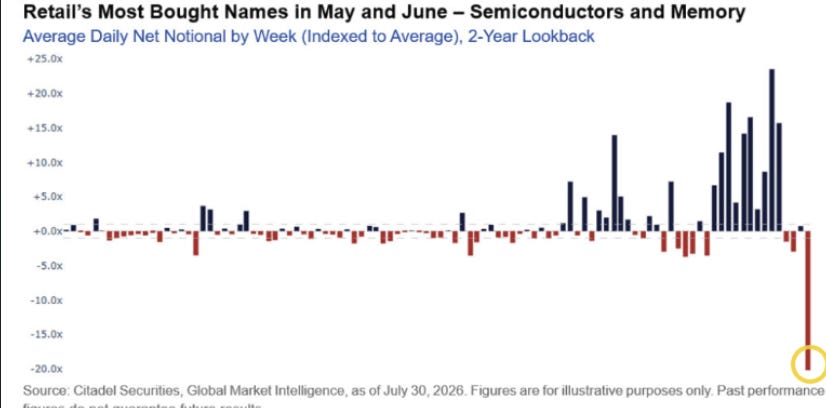
The self licking ice Cream that we referred to last year as the new zAIbatsu and the questions about the return on Investment in all the AI that we discussed in Where are the customers’ yachts are all starting to come to the fore as the memory stocks give back most of their recent gains. Speculators have been burned, but we note that retail has been selling into the technical bounce. As the chart at the top of the note shows.
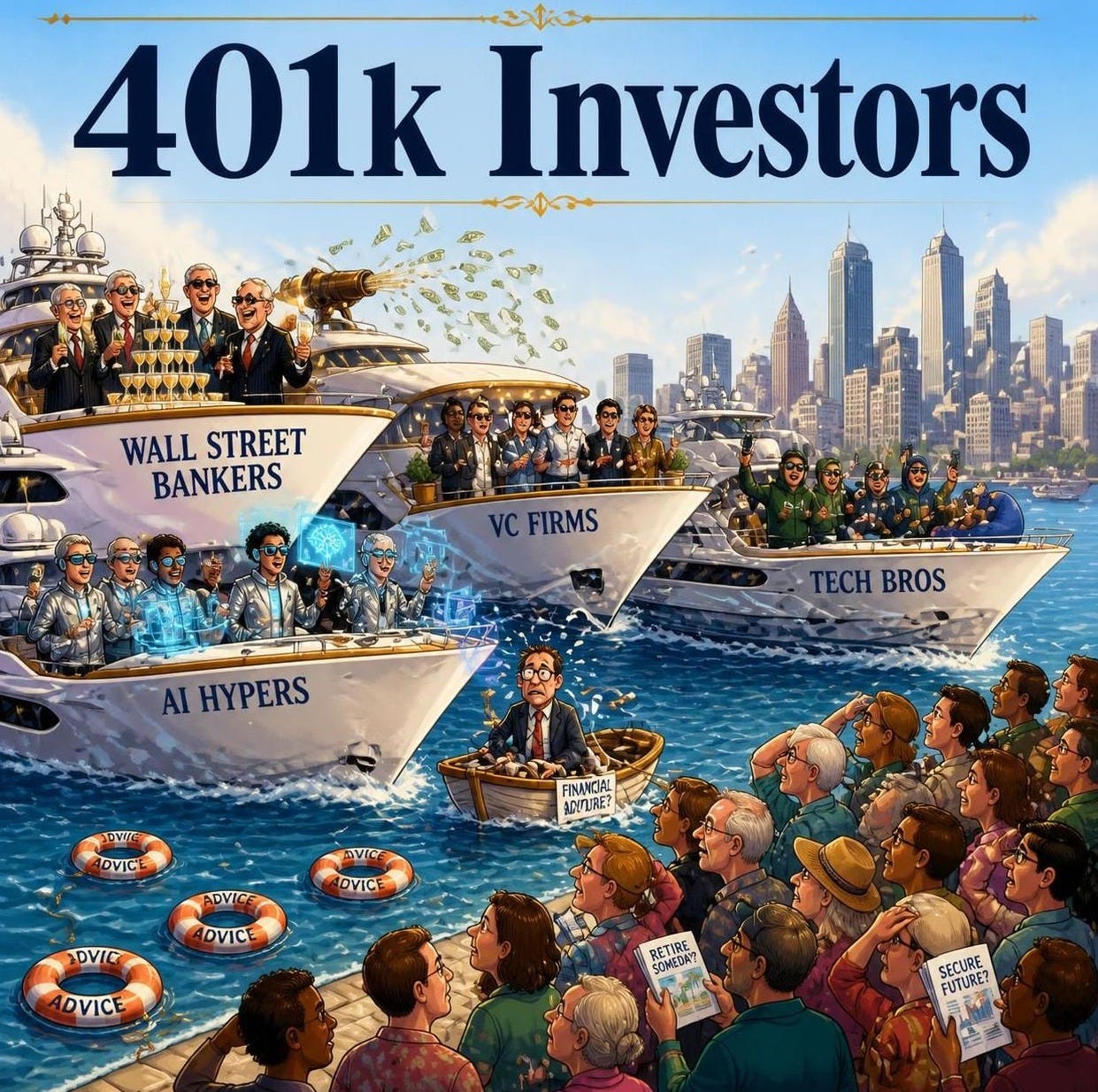
Retail, whether through ETFs or 401ks, are the ultimate source of liquidity for multiple leveraged financial structures assembled over the last decade. The Middle East Sovereign wealth funds, previously seen as a cornerstone for most exit strategies (sorry opportunities) are facing cash constraints thanks to the war and other demands for future spending such that they certainly aren’t going to tie themselves up in illiquid strategies. The cash rich tech companies are no longer recycling cash via buybacks or using their stock to buy out all the smaller tech startups and indeed are sucking up huge amounts of available liquidity via debt and equity issuance (see the Silicon Valley liquidity sponge).
Meanwhile, the first Mega IPO, of Space X, looks like it was spoiled the party for those wanting to follow on. Down between 25% and 50%, it is going to be difficult to hype up retail a second time. Fool me once…
401K are down 25-45%, who is going to buy Open AI and Anthropic?
The AI Bubble is not just in Equities, indeed the problem is that, as usual, it is really in the debt markets. This is much more like 2008 than 2000. For all the hype about the Space X IPO raising $80bn, Google raised more than that in debt the previous week, while Meta has huge contingent liabilities associated with its underwriting of its future customers.
But pressure is mounting. Amazon just issued $25bn of debt that was barely 1.3x covered and Oracle, the centre of the circular financing bubble, just saw its credit downgraded to one notch above junk by S&P Global (as reported by the great Ed Zitron.) The S&P Global rationale makes sobering reading. Oracle is down 20% over the last month, while Coreweave, the cloud based GPU provider sometimes referred to as a neocloud and a competitor for selling ‘compute’ is down over 30% and, as shown in the graphs above, the CDS price (essentially the cost of insuring against default on the debt) keeps going higher.
The gap between committed spending and the ability to raise debt to fund it is now key. Coreweave has already raised $23bn in debt and needs even more to match its guidance of $35bn of cap-ex. The fact that the same $ of spend has appeared on multiple income statements and balance sheets means that, should the debt not be forthcoming, or the build not happen, then that same missing $ collapses multiple business plans.
Ed Zitron writes long and quite dense (as well as occasionally potty mouthed) pieces on all this that are definitely worth reading and in this one he highlights, inter alia, the role of Nvidia and Softbank in holding the ring on all this circular financing and how an affiliate of Softbank, with no experience of building datacentres is looking to raise debt by getting a backstop from Nvidia, which will then sell it hundreds of billions in GPUs and then Softbank will use a contract signed with Open AI to take the affiliate public and give it and Open AI a huge equity gain.
If it sounds complicated, it is because it is. And, as Ed puts it, highly unlikely to happen (although he puts it more bluntly). Currently 54% of revenue and 64% of accounts receivable of the biggest company in the world by market cap come from just three customers.
Outside of those building the infrastructure, the only people making a profit (or really much money at all) are the bankers and private credit funds underwriting data center debt, the ratings agencies getting paid to rate that debt, and any VC that’s been lucky enough to get paid out across the (very) few acquisitions of the AI bubble so far.
Otherwise, basically every layer of the AI industry exists to be exploited by the layer above it. AI startups and enterprise customers pay Anthropic and OpenAI on a per-million token rate (losing money in the process) so that Anthropic and OpenAI can rent GPUs from hyperscalers (losing tens of billions of dollars a year) so that hyperscalers can buy a trillion or more dollars’ worth of GPUs (putting them in such a hole that they’ll never, ever be able to make the money back).
And don’t forget the Chinese competition. The IPO of CXMT in July, (see DRAMatic Price Moves) raised $8.5bn, not to allow insiders to exit so much as to allow the number 4 player in Global Memory to compete at the cutting edge. The fact that Apple are considering using them is an interesting exercise in shifting pricing power, as is the growing use of Chinese AI models for scale users. The price difference is so vast that the premium pricing for Open AI and Anthropic - essential to their IPO valuations, looks unsustainable.
The risks to the IPOs and the risk of a synthetic ‘downround’ are real and growing. Google, Microsoft, Softbank and others have all reported large ‘investment gains’ on their positions in Open AI and Anthropic - EPS growth viewed cautiously at the stock level, but not, we suspect, at the aggregate level, where sector and market multiples look ‘cheaper’ than they really are.
Long Term Trends - energy, AI and banks
One reason why a resumption of the war in Iran may have led to lower rather than higher crude oil prices is that refining capacity is being targeted, meaning gasoline prices might be going higher worldwide, but not in the US , which is the only real place it is politically significant at the moment. Lower demand for crude due to lack of refining capacity means lower crude prices but higher prices for refined product and is then better for crack spreads. The US and refiners win, everybody else loses.
When the Iran War broke out, hot on the heels of the seizure of Venezuelan oil assets, we noted that one of the few explanations that made sense from a US Foreign Policy perspective was that there was a plan to control the world’s oil and gas assets. In a note back in April (Art of the no deal) we highlighted two, closely aligned, theories from Brian Berletic and Richard Medhurst, The first, that targeting global energy supplies is specifically an indirect attack on China and the second that it is all about preserving the hegemony of the US petro $, or as Richard Medhurst puts it, the Petrogas-dollar. The theories are also supported by Economist Michael Hudson, whose work on Super-Imperialism is a must read, but his theory is broader, that the Team Trump mindset is one of creating monopoly rents, of controlling energy, of controlling AI.
Whether deliberate or not, the Ukraine war, sanctions and the sabotage of the Nordstream pipeline pushed Russian energy out of Europe, while the Iran war has taken out both Iran’s supplies of gas and also the number 2 competitor to the US, Qatar. The US is now comfortably the world’s biggest exporter of Oil and gas and, unlike previously, is a beneficiary of high oil prices.
It is also of course a key reason why Trump is interested in Greenland, not just for its rare earths, but because of its strategic position to enable a blockade of Russian tankers in the Arctic/Baltic. Since then, there have been multiple attacks on Russia’s ‘shadow fleet’ of tankers to further disrupt supplies to China and, again possibly coincidentally, the Ukraine drone attacks on the Russian mainland all seem to be focussed on its energy facilities and infrastructure - just as much of the US attacks on Iran seem to be on pipelines serving the new Silk Road. As he puts it, the three US initiatives all appear to have the same ‘result’, restricting oil and gas exports to China.
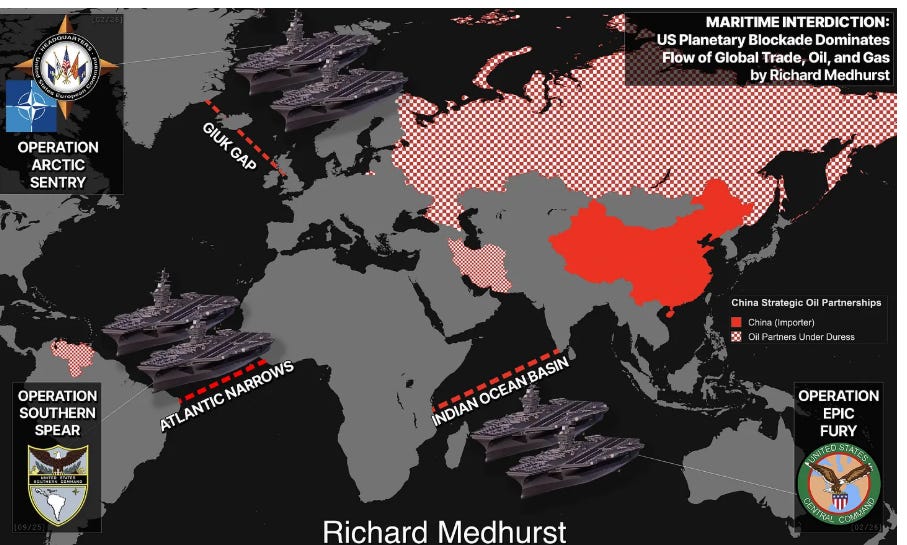
Which brings us, inevitably, to China itself.
Currently, we can think of China as importing energy from the rest of the world and then exporting ‘processed energy’ in the form of energy intensive goods back to the world. The US is currently keen to keep the payments for the imports in US$, which is a key reason, acknowledged by Scott Bessent, for seeking to control energy supplies. If and when it stops doing this, it will be because it has created energy independence through a combination of nuclear, coal, renewables (and their mass storage) and, ultimately, but coming on at a pace, Fusion (what the great Pippa Malgram calls ‘a star in a box’).
As China becomes energy independent, it will need fewer $ and thus fewer exports. As such it is already minded to allow the Rmb to appreciate and import from the rest of the world - not unlike Japan, Germany and indeed the US have done in the past. This may well start as soon as the autumn - the recent US intervention in the Yen highlighting the renewed focus on currencies as a policy tool. We note that several emerging countries have started issuing Panda bonds - sovereign debt in Rmb and also that international investors are looking once more at Chinese assets.
As to controlling AI, that plan is also unravelling as the US ‘leaders’ are not only being caught up but even overtaken by Chinese Open Source models which cost a fraction of the price that the US companies are charging in order to fund their trillion dollar roll-outs. And just as CXMT, the Chinese chip manufacturer is not at the cutting edge of technology, the bulk of the profits in a scale business are made at the average, not the peak, price.
Long term equity returns are around 7-8%. In recent years, they have been two or even three times that, helped by multiple expansion as interest rates fell, but also by a US market index increasingly dominated by high margin businesses with economic moats derived from technology, but also regulation and ‘aggressive’ use of financing.
China is challenging all of this.